VHDL Digital Systems & FPGA Logic Design
Modular digital logic and FPGA hardware description library in IEEE VHDL: multi-floor elevator FSM, synchronous request queue, 2's complement ALU, and registers.
Project Overview
A modular digital logic and FPGA hardware description library written in IEEE standard VHDL, developed for the Digital Systems Design curriculum at the University of Brighton and earning a First Class 84% (A+).
The repository implements synchronous finite state machines (FSMs), priority request arbitration queues, arithmetic sub-units (ALUs, ripple adders, multipliers, magnitude comparators), sequential shift registers, and seven-segment display decoders synthesised in Intel Quartus Prime and verified through gate-level timing simulations in ModelSim.
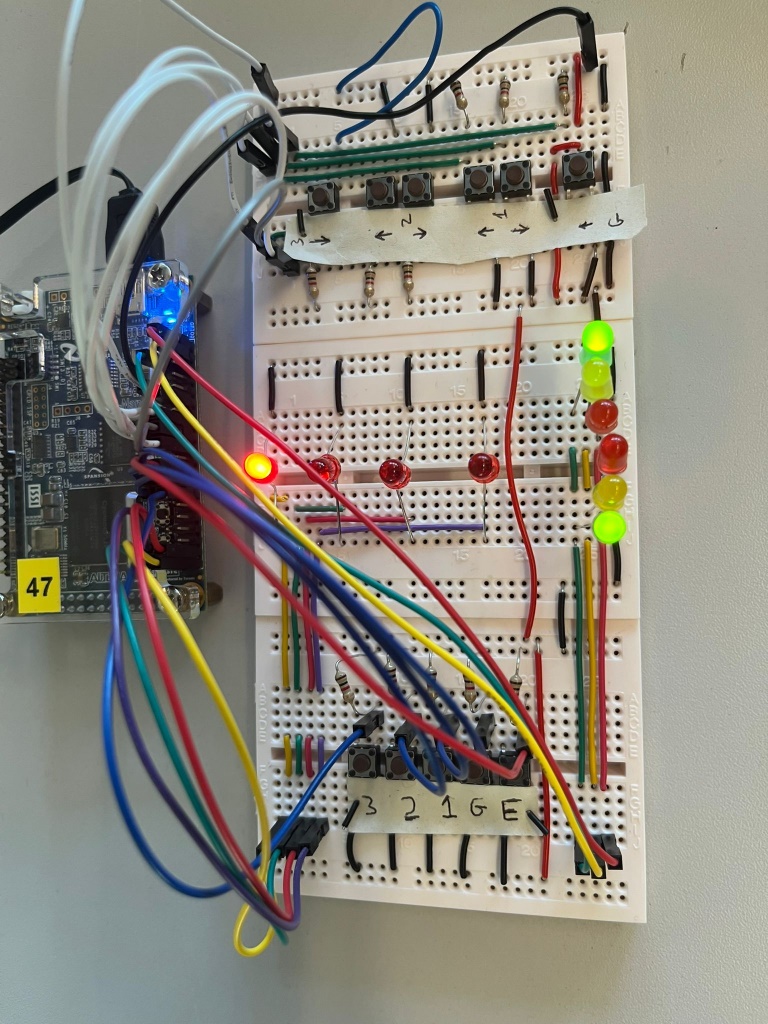
Physical FPGA Hardware Testbed
The flagship multi-floor elevator controller was compiled onto an Altera/Intel Cyclone FPGA and deployed to a physical hardware testing harness consisting of tactile floor call switches, emergency stop buttons, and LED position indicators:
ModelSim Timing Simulation & Verification
Prior to silicon programming, the complete digital architecture underwent cycle-accurate timing simulation in ModelSim to verify setup/hold slack, asynchronous reset handling, and state transition latency:
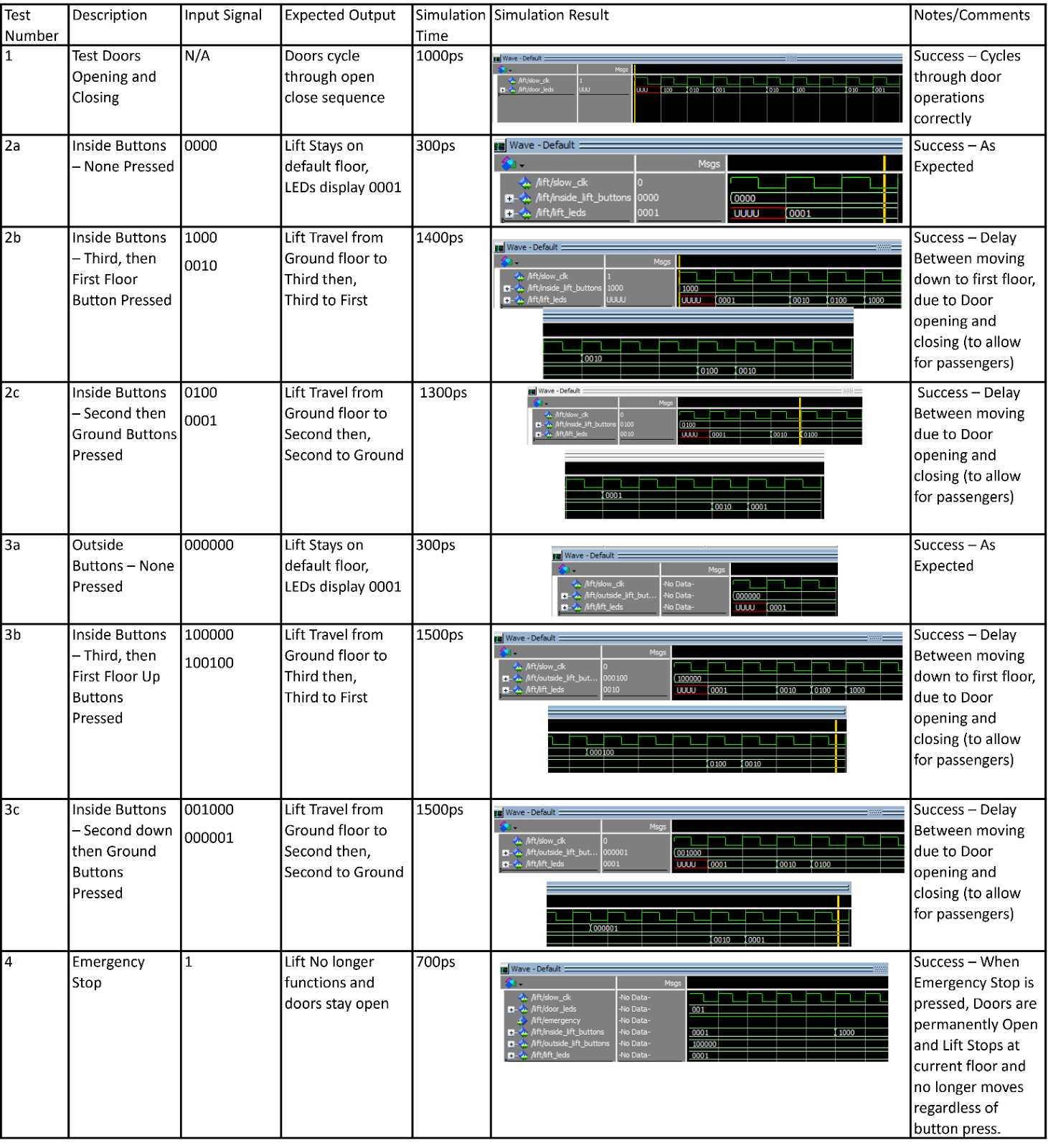 Figure 1: ModelSim functional and timing waveform trace illustrating clock edge alignment, floor queue arbitration, door open/close timeouts, and state register transitions.
Architecture Specifications: Multi-Floor Elevator Controller
| Subsystem Module | Entity Name | Description | Key Signals |
|---|---|---|---|
| Main FSM Controller | Lift.vhd |
Finite state machine coordinating motor direction, floor arrival, and door sequencing. | clk, reset, floor_req, motor_up, motor_down, door_open |
| Synchronous Queue | Queue.vhd |
FIFO/priority queue latching external floor calls and scheduling the shortest path. | req_in, serviced, next_target |
| Door Actuator | doors_but_better.vhd |
Timed door cycle controller with safety obstacle pause and auto-retract. | door_sensor, timer_done, door_state |
| Clock Prescaler | clock_div1.vhd |
Integer clock divider converting 50 MHz FPGA system clock down to 1 Hz visual update pulses. | clk_50MHz, clk_1Hz |
| Display Decoder | bin2hex.vhd |
4-bit binary to active-low 7-segment hex character mapping. | data_in[3:0], seg_out[6:0] |
VHDL Finite State Machine Implementation
The core elevator logic is structured as a two-process synchronous FSM separating combinatorial next-state logic from clocked sequential state registers:
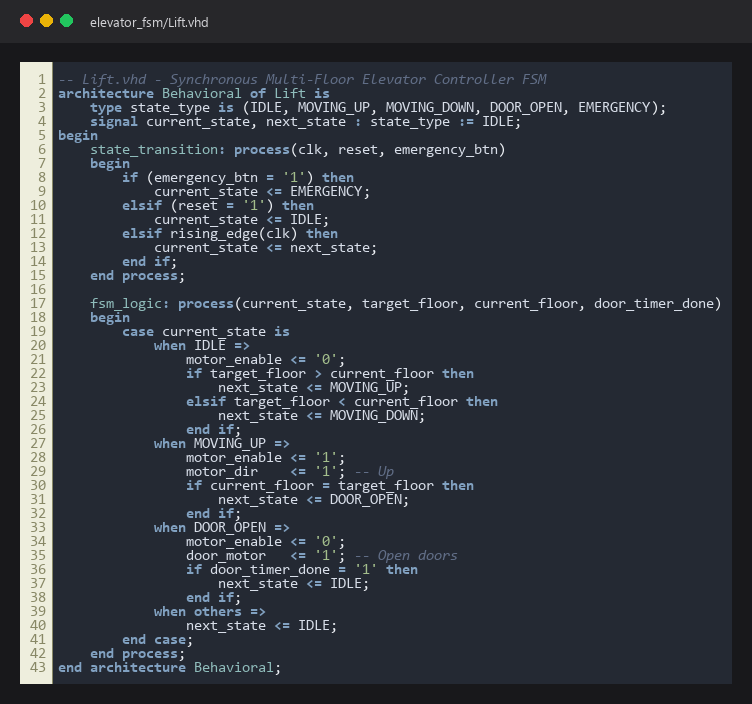 Figure 2: Carbon-style syntax-highlighted IEEE VHDL listing defining the finite state enumeration (
IDLE, MOVING_UP, MOVING_DOWN, DOOR_OPEN), clock synchronisation process, and next-state transition logic.
Arithmetic & Sequential Building Blocks
In addition to the elevator system, the repository contains a library of synthesiseable digital logic primitives:
1. Original RTL by Harry Rogers
bitMultip.vhd: Combinational 2-bit binary multiplier array.Comp4.vhd: 4-bit unsigned magnitude comparator ($A > B$, $A = B$, $A < B$).Sub4.vhd: 4-bit dedicated binary subtractor.full_adder_vhdl_code.vhd: Structural 1-bit full adder primitive with carry propagation.bin2hex.vhd: 4-bit binary to 7-segment hex display decoder.clock_div1.vhd: Synchronous integer clock frequency prescaler.
2. University Coursework Reference Modules (Designed by Chris Knight)
Adder_Sub.vhd: Selectable ripple-carry adder/subtractor provided as laboratory coursework reference material.Counter.vhd&CounterTB.vhd: Synchronous up/down counter reference implementation.ShiftReg1.vhd: 4-bit shift register reference implementation.
Source Code & Academic Attribution
- GitHub Repository: HarryRogers073/vhdl-digital-systems
- Author: Harry Rogers (University of Brighton)
- Coursework Context: Digital Systems Design (First Class 84%, A+)
- Synthesis & P&R: Intel Quartus Prime Lite / Standard Edition
- Simulation: ModelSim-Intel FPGA Starter Edition
- Hardware Target: Altera / Intel Cyclone II / IV / DE2 Development Boards